
Continuous IT Support: Why Your Company Needs a Technology Ally, Not Just a Contractor
Technology has ceased to be a support department. Today it is a direct part of operations, reputation, and the growth capacity of any serious company. When corporate email fails, when a server goes offline, when a backup does not restore, when an employee cannot access their tools, or when a security breach compromises sensitive information, the problem is no longer “technical.” It is operational, financial, legal, and reputational.
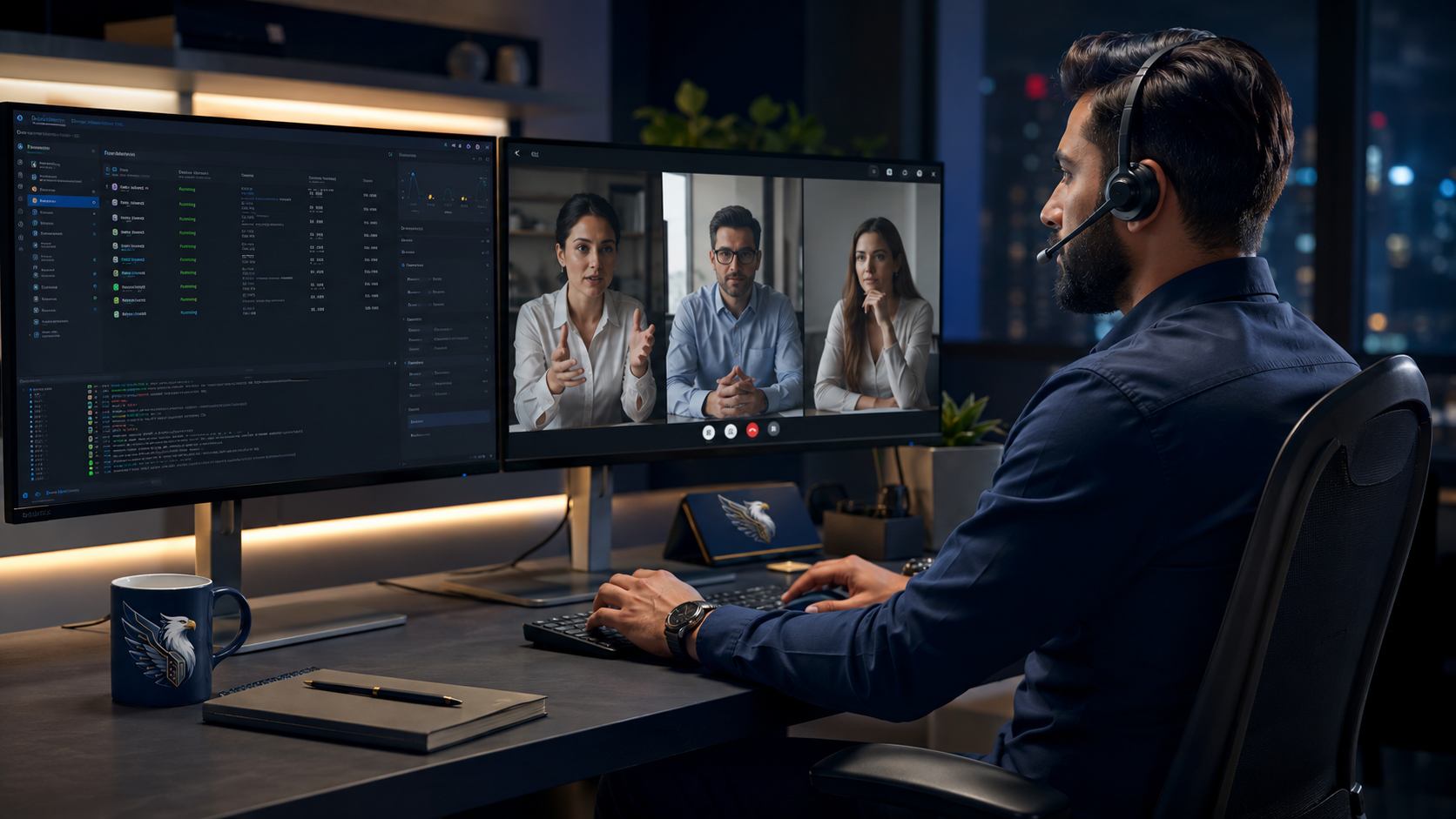
Technology has ceased to be a support department. Today it is a direct part of operations, reputation, and the growth capacity of any serious company.
When corporate email fails, when a server goes offline, when a backup does not restore, when an employee cannot access their tools, or
when a security breach compromises sensitive information, the problem is no longer “technical.” It is operational, financial, legal, and reputational.
That is why modern IT support cannot be limited to sending a technician when something breaks. Companies that depend on systems, data, customers, payments, communications, and digital processes need an ally that monitors, maintains, documents, automates, and responds continuously.
That is the mindset shift: moving from reactive support to permanent technological accompaniment.
1. The market has already confirmed the trend: companies are outsourcing critical technology
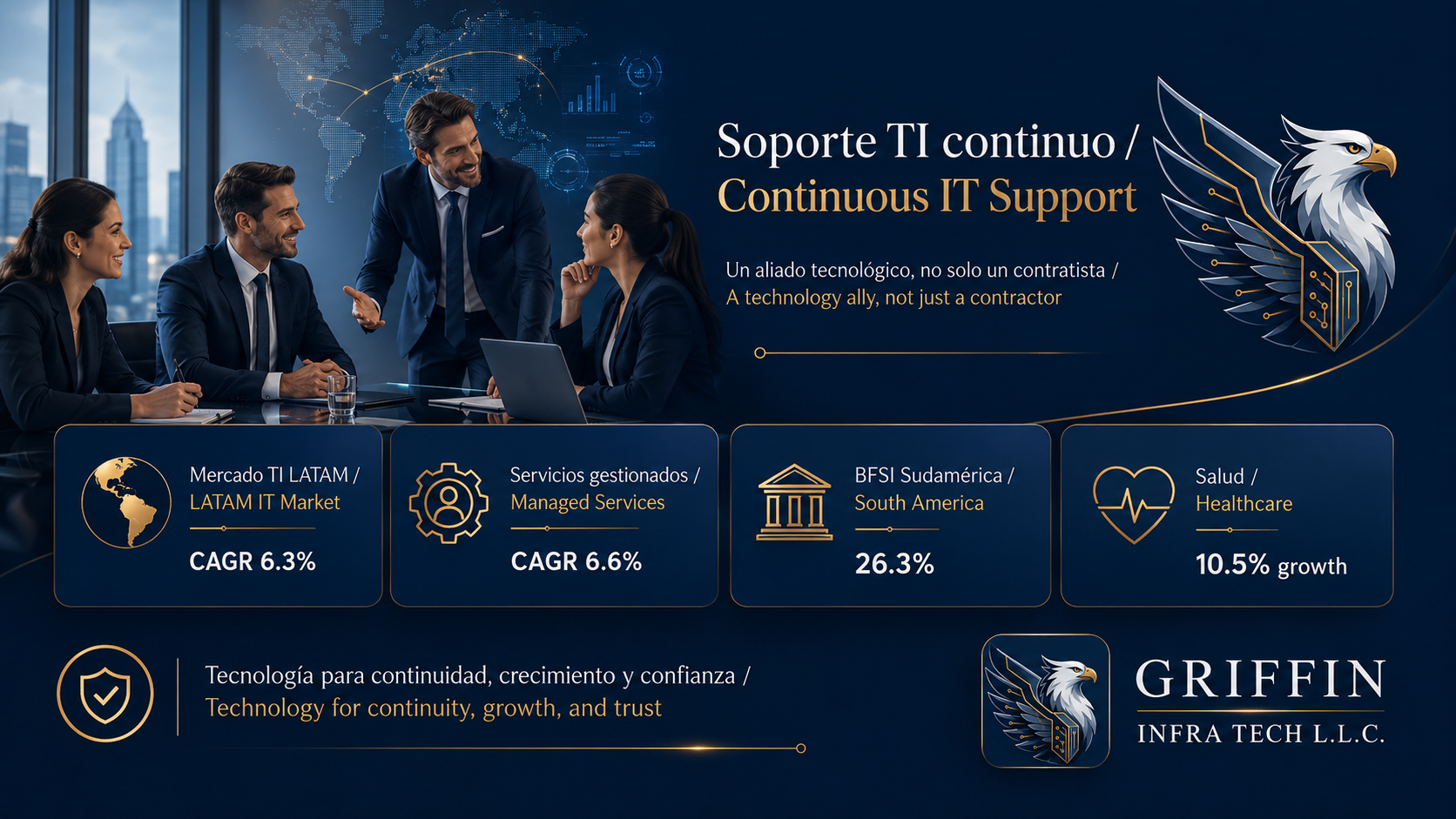
Latin America is going through a clear stage of digital maturation. According to Expert Reports, the IT services market in Latin America reached approximately USD 31.50 billion in 2025 and is projected to reach USD 54.58 billion by 2035, with an estimated compound annual growth rate of 6.3% between 2026 and 2035.
The trend is not isolated. MarketsandMarkets projects that the Latin American managed services market will grow from USD 24.64 billion in 2025 to USD 33.94 billion by 2030, at a compound annual rate of 6.6%. The explanation is straightforward: companies are facing increased complexity in cloud, cybersecurity, hybrid infrastructure, communications, remote support, business continuity, and compliance.
Globally, Gartner estimated in April 2026 that worldwide IT spending will reach USD 6.31 trillion in 2026, driven by AI infrastructure, software, data centers, and technology services. This shows a reality that no prudent business owner should ignore: technology is not losing importance; it is absorbing more and more responsibility within the company.
For a medium-sized or growing organization, trying to sustain all of this solely with improvised internal staff or occasional contractors is a weak decision. It may seem cheap at first, but it often becomes expensive when a critical failure occurs.
2. The real cost is not paying for support; it is not having it when you need it
A server down for several hours can halt billing, sales, customer service, administrative operations, and internal communication. A poorly configured access can expose data. An untested backup can become a false sense of security. An infected machine can compromise an entire network.
The cost of technological negligence usually appears late, but it appears with force.
IBM, in its Cost of a Data Breach Report 2025, placed the global average cost of a data breach at USD 4.44 million. Sophos, in The State of Ransomware 2025, reported that the average recovery cost from a ransomware attack, excluding ransom payment, was approximately USD 1.53 million. These figures do not mean that every company will suffer losses of that magnitude, but they do make one thing clear: prevention, monitoring, rapid response, and well-designed backups are not luxuries; they are measures of business survival.
Continuous IT support is not justified simply because “someone must fix computers.” It is justified because it reduces exposure, improves continuity, and allows decision-making based on data, records, and procedures.
3. From firefighting to operating with technological discipline
The traditional support model works like this: something fails, someone calls, a technician checks, it gets partially resolved, no sufficient documentation remains, and the cycle repeats.
That model is insufficient for a company that aspires to grow.
The right model must include:
- Preventive monitoring of equipment, servers, services, backups, and availability.
- Orderly management of users, access, passwords, and permissions.
- Maintenance of workstations, operating systems, and critical applications.
- Periodic security reviews, updates, and configurations.
- Backup policies with actual restoration tests.
- Technical documentation to avoid dependency on a single person.
- Automation of repetitive tasks.
- Efficient remote support and escalation when the incident requires it.
- Executive reports understandable by management.
The difference is fundamental. The contractor corrects incidents. The technology ally reduces the probability of incidents occurring, responds when they occur, and leaves the infrastructure better than before.
4. Why this matters especially for banking, fintech, commerce, and professional services
Financial, commercial, and professional sectors cannot afford to operate with weak infrastructure. A bank, an accounting firm, a legal services company, a fintech, a logistics company, or a commerce operation with digital presence depends on three critical assets: information, availability, and trust.
When those assets deteriorate, the damage is not always visible on an immediate invoice. It shows up in customers losing trust, processes being delayed, more difficult audits, unproductive teams, loss of traceability, and legal exposure.
In these sectors, IT support must have an operational continuity mindset. It is not enough to install software or configure emails. You must understand risks, workflows, priorities, critical hours, access levels, information backup, external providers, compliance, and acceptable recovery times.
A serious company does not buy technical support like a one-time repair. It buys stability, vigilance, and response capability.
5. Artificial intelligence and automation: real opportunity, but with technical governance
Artificial intelligence is entering administrative processes, customer service, document analysis, report generation, internal support, and workflow automation. Used well, it can save time and improve productivity. Poorly implemented, it can create security risks, information leakage, dependency on uncontrolled tools, and operational errors.
That is why AI should not be treated as a trendy toy. It must be incorporated with technical judgment:
- Define which processes can be automated and which cannot.
- Establish controls over sensitive data.
- Integrate tools with appropriate permissions.
- Document workflows.
- Measure real results.
- Train the team.
- Maintain human oversight for critical decisions.
Continuous IT support must evolve toward a model where infrastructure, security, and automation work together. The company does not need more scattered applications; it needs architecture, control, and accompaniment.
6. What a company should demand before hiring continuous IT support
Before hiring a technology provider, management should ask specific questions:
- Does the provider document the infrastructure or just resolve tickets?
- Does it have defined response times?
- Can it provide secure remote support?
- Does it work with tested backups or just “configured” ones?
- Can it explain risks in executive language?
- Does it sign confidentiality agreements when appropriate?
- Does it have the judgment to separate real emergencies from minor requests?
- Can it help scale infrastructure without improvisation?
- Does it deliver periodic reports?
- Does it have a preventive or merely reactive approach?
The answers to these questions reveal whether the company is hiring technical labor or an operational partner.
7. The role of Griffin Infra Tech: vigilance, infrastructure, and trust
Griffin Infra Tech L.L.C. was born with a clear idea: companies need technology that works with order, security, and continuity. It is not enough to solve isolated problems. You must build a serious technological foundation so that operations can grow without getting trapped in recurring failures.
The griffin precisely represents that vision: vigilance, protection, and mastery over critical infrastructure. Not as a decorative symbol, but as a working principle.
Our approach focuses on accompanying companies that need remote IT support, infrastructure management, Linux servers, automation, backup, operational security, and continuous improvement. We work to make technology a business advantage, not a permanent source of disruptions.
We can provide value in areas such as:
- Remote IT support for teams and users.
- Basic and advanced administration of Linux servers.
- Implementation and maintenance of corporate websites.
- Management of corporate email and domains.
- Process automation with digital tools and artificial intelligence.
- Operational security reviews.
- Backup organization and continuity.
- Technical documentation of infrastructure.
- Monthly technological accompaniment for companies that need stability.
The goal is not to sell complexity. It is to reduce uncertainty.
8. A business decision, not just a technical one
The prudent business owner understands that technology must be taken care of before it fails. Waiting for an incident to act is an expensive way to manage risk.
Continuous IT support allows you to bring order to operations, reduce improvisation, improve security, free up internal team time, and prepare the company to grow. It also enables something many organizations underestimate: having someone watch over the infrastructure with judgment, consistency, and responsibility.
Digital transformation does not begin by buying more tools. It begins by building a reliable foundation.
And a reliable foundation needs vigilance.
Conclusion: Your company does not just need a technician; it needs a technology guardian
In an increasingly digital, regulated, exposed, and competitive market, continuous IT support is no longer a secondary service. It is a layer of protection and efficiency for the company.
Organizations that treat technology as an expense tend to react too late. Those that treat it as strategic infrastructure build advantage.
Griffin Infra Tech L.L.C. is designed to accompany companies that want to operate with greater security, more order, and greater growth capacity.
If your company needs to review its infrastructure, improve its support, organize its systems, or prepare a more solid technological foundation, we can talk.
Schedule an initial 30-minute consultation, and let us evaluate where your operation stands today, what risks exist, and what improvements can be implemented with business judgment.
Sources and references
- Expert Reports. “IT Services Market in Latin America | 2035.” https://www.informesdeexpertos.com/informes/mercado-de-servicios-de-ti-en-america-latina
- MarketsandMarkets. “Latin America Managed Services Market.” https://www.marketsandmarkets.com/Market-Reports/latin-america-managed-services-market-23311157.html
- MarketsandMarkets. “Latin America Managed Services Market worth $33.94 billion by 2030.” https://www.marketsandmarkets.com/PressReleases/latin-america-managed-services.asp
- Gartner. “Gartner Forecasts Worldwide IT Spending to Grow 13.5% in 2026, Totaling $6.31 Trillion.” https://www.gartner.com/en/newsroom/press-releases/2026-04-22-gartner-forecasts-worldwide-it-spending-to-grow-13-point-5-percent-in-2026-totaling-6-point-31-trillion-dollars
- IBM. “Cost of a Data Breach Report 2025.” https://www.ibm.com/reports/data-breach
- Sophos. “The State of Ransomware 2025.” https://www.sophos.com/en-us/content/state-of-ransomware
- McKinsey & Company. “Getting business process outsourcing right in a digital future.” https://www.mckinsey.com/capabilities/operations/our-insights/getting-business-process-outsourcing-right-in-a-digital-future
- Deloitte. “Global Outsourcing Survey 2024.” https://www.deloitte.com/global/en/issues/work/global-outsourcing-survey.html
Written by: Iván Guerrero CEO & Director, Griffin Infra Tech — Assisted by AI for research and drafting efficiency.