
Hermes Agent: From Conversational AI to Intelligent Automation for Critical Businesses
Enterprise automation is entering a new stage. For years, many organizations have relied on scripts, scheduled tasks, and rigid workflows to optimize operational processes. These solutions remain useful, but they are increasingly limited in environments where speed, business continuity, traceability, and responsiveness are becoming essential.
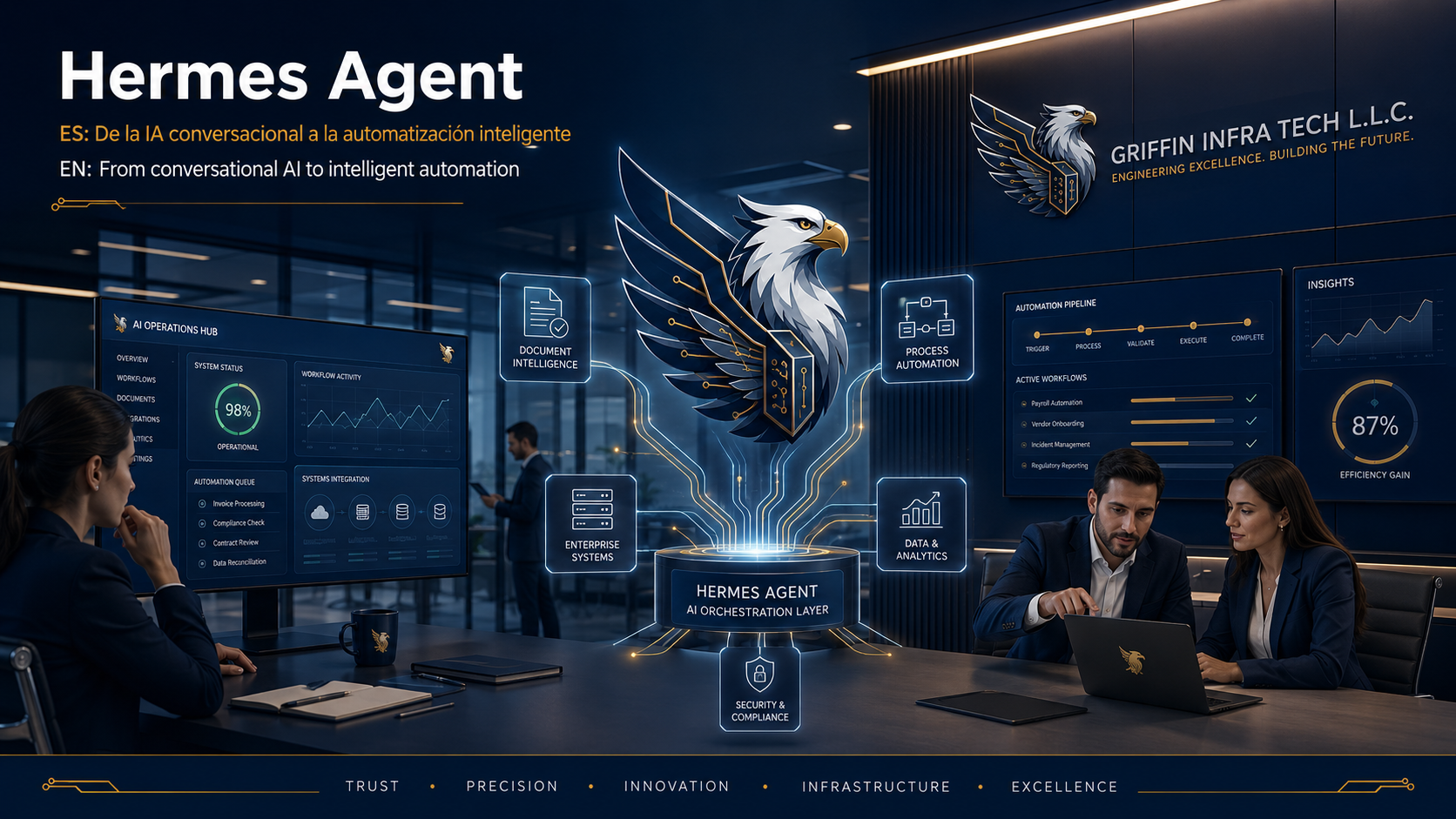
In critical sectors such as banking, logistics, fintech, telecommunications, manufacturing, and fast-growing technology companies, teams no longer need only to automate repetitive tasks. They also need systems capable of understanding context, integrating with existing tools, operating continuously, and adapting to changing business needs.
This is where artificial intelligence agents emerge as a natural evolution of traditional assistants. The objective is no longer limited to having a conversation with AI. The real value is working with systems capable of supporting real processes: reviewing information, executing tasks, coordinating tools, preserving operational context, and facilitating decisions across the organization. From Nous Research to Hermes Agent. Nous Research is part of the open-source artificial intelligence ecosystem, with a focus on model development, distributed infrastructure, and open tools for the technology community.
This approach is relevant for businesses because the future of enterprise AI will not depend exclusively on closed models. Many organizations will require solutions that are more flexible, auditable, and adaptable to their own technical, regulatory, and operational environments.
In sectors such as banking, fintech, and telecommunications, control over infrastructure, data, and processes is essential. In logistics, manufacturing, and operations, the ability to integrate with existing systems is often more valuable than a simple conversational interface. For that reason, modular and adaptable AI agents can become a strategic component of digital transformation initiatives.
Hermes Agent points precisely in that direction: an AI system that does not only converse, but can also integrate into real processes, interact with tools, and serve as operational support within different technological environments.
Business Applications of Hermes Agent
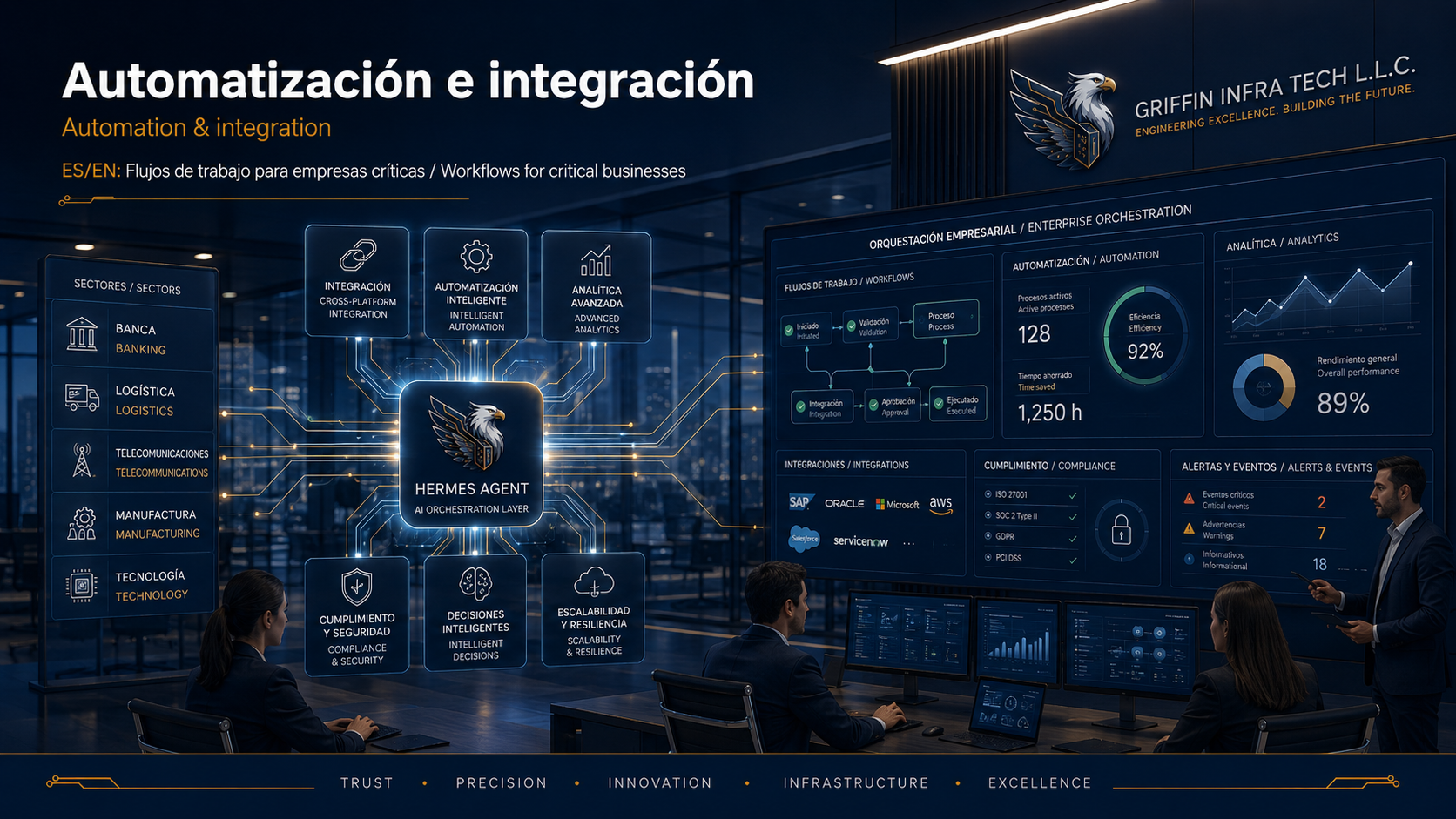
The commercial potential of Hermes Agent lies in its ability to transform technical, repetitive, and documentation-heavy tasks into more intelligent automated workflows.
In a technology company, for example, Hermes could be used to review internal documentation, generate technical summaries, organize recurring tasks, or support DevOps and infrastructure processes. In a fintech company or banking institution, it could serve as an operational assistant for documentation, internal reporting, non-sensitive process monitoring, and technical team support under appropriate control, security, and human supervision policies.
In logistics, it could help consolidate operational information, generate status reports, review incidents, or coordinate tasks across different platforms. In manufacturing, it could support activities related to maintenance, technical documentation, process tracking, and operational information analysis.
Figure 3. Conceptual architecture of Hermes Agent applied to enterprise environments, showing integration with corporate channels, automation of operational processes, and benefits in efficiency, scalability, and business continuity.
Source: Created with artificial intelligence.
Enterprise Use Cases
Hermes Agent can be integrated as an intelligent automation layer within business operations, helping optimize processes, reduce manual work, and improve team responsiveness.
Its flexible architecture allows it to interact with systems, platforms, and information sources to automate workflows, consolidate data, generate actionable knowledge, and support operational decision-making.
For example, it can help monitor technology infrastructure, correlate information from multiple systems, and generate automated executive reports for operations, technology, and management teams.
It can also contribute to structuring corporate documentation, centralizing organizational knowledge, and supporting processes related to audit, regulatory compliance, traceability, and document management.
Figure 4. Conceptual representation of Hermes Agent as an operational automation layer for organizations, integrating knowledge, processes, and enterprise systems to drive efficiency, scalability, and technological resilience.
Source: Created with artificial intelligence.
Among its most relevant enterprise applications are:
- Automation of operational, executive, and management reports.
- Knowledge management and corporate documentation.
- Monitoring of infrastructure, services, and operational events.
- Automation of internal processes and recurring tasks.
- Support for compliance, audit, and traceability initiatives.
- Integration and orchestration of workflows across multiple platforms.
- Consolidation and analysis of information for decision-making.
More than a conversational assistant, Hermes Agent can become an operational automation platform capable of integrating into business processes to strengthen efficiency, operational continuity, and organizational scalability.
Why AI Agents Will Matter for Businesses
The evolution of artificial intelligence is moving toward systems that are more autonomous, contextual, and integrated. Organizations are no longer looking only for tools that generate text or answer questions; they are looking for solutions that improve processes, reduce execution times, automate tasks, and enable more intelligent operations.
AI agents can become an intermediate layer between people, systems, and data. Their function is not to replace teams, but to increase their operational capacity, reduce internal friction, and accelerate repetitive or information-intensive tasks.
Figure 5. Conceptual representation of the transition from AI assistants focused on responses to intelligent agents capable of executing processes, integrating with corporate systems, and supporting enterprise operational efficiency.
Source: Created with artificial intelligence.
Hermes Agent represents this transition through four key capabilities:
- Contextual memory.
- Continuous automation.
- Tool integration.
- Adaptability to different environments and models.
In business terms, this can translate into lower operational workload, faster execution, better use of internal knowledge, and a more consistent operation.
Conclusion
Hermes Agent shows where AI-driven enterprise automation is heading. The future will not be defined only by chatbots that answer questions, but by agents capable of maintaining context, executing tasks, integrating with tools, and actively participating in real operational processes.
For companies in critical sectors such as banking, logistics, fintech, telecommunications, manufacturing, and technology, this type of solution can become a strategic competitive advantage. It is not simply about adopting AI because it is a trend; it is about building a more efficient, resilient, scalable operation prepared to face new technological and business challenges.
Figure 6. Conceptual illustration of Hermes Agent and its main capabilities for automation, information organization, and operational assistance.
Source: Created with artificial intelligence.
Hermes Agent represents an evolution within enterprise digital transformation: the shift from conversational assistants to intelligent agents capable of integrating with systems, automating workflows, and producing operational results. More than a productivity tool, it proposes a vision in which artificial intelligence becomes a strategic operational layer designed to drive productivity, automation, and technological resilience across organizations.
References
Hermes Agent — Official website:
https://hermes-agent.nousresearch.com/
Hermes Agent — Official GitHub:
https://github.com/NousResearch/hermes-agent
Nous Research:
Analysis of Hermes Agent in Turing Post:
https://www.turingpost.com/p/hermes
Introduction to AI Agents — DataCamp:
https://www.datacamp.com/es/blog/ai-agents
Acknowledgments
This article was written by Gelois, an independent researcher and technology communicator focused on artificial intelligence, automation, and enterprise technology.
We acknowledge his intellectual contribution to the development of this content and his analysis of the role of artificial intelligence agents in the digital transformation of businesses.
Author: Gelois X / Twitter: https://x.com/Gelois_0 Contact: gelois@protonmail.com