
Secure Digital Infrastructure: The Invisible Foundation of Every Modern Business
Introduction Every modern business depends on its digital infrastructure, even when it is not seen as a central part of the company. Servers, networks, workstations, backup systems, monitoring, access controls, technical documentation, and security practices support operations that appear to run naturally every day.
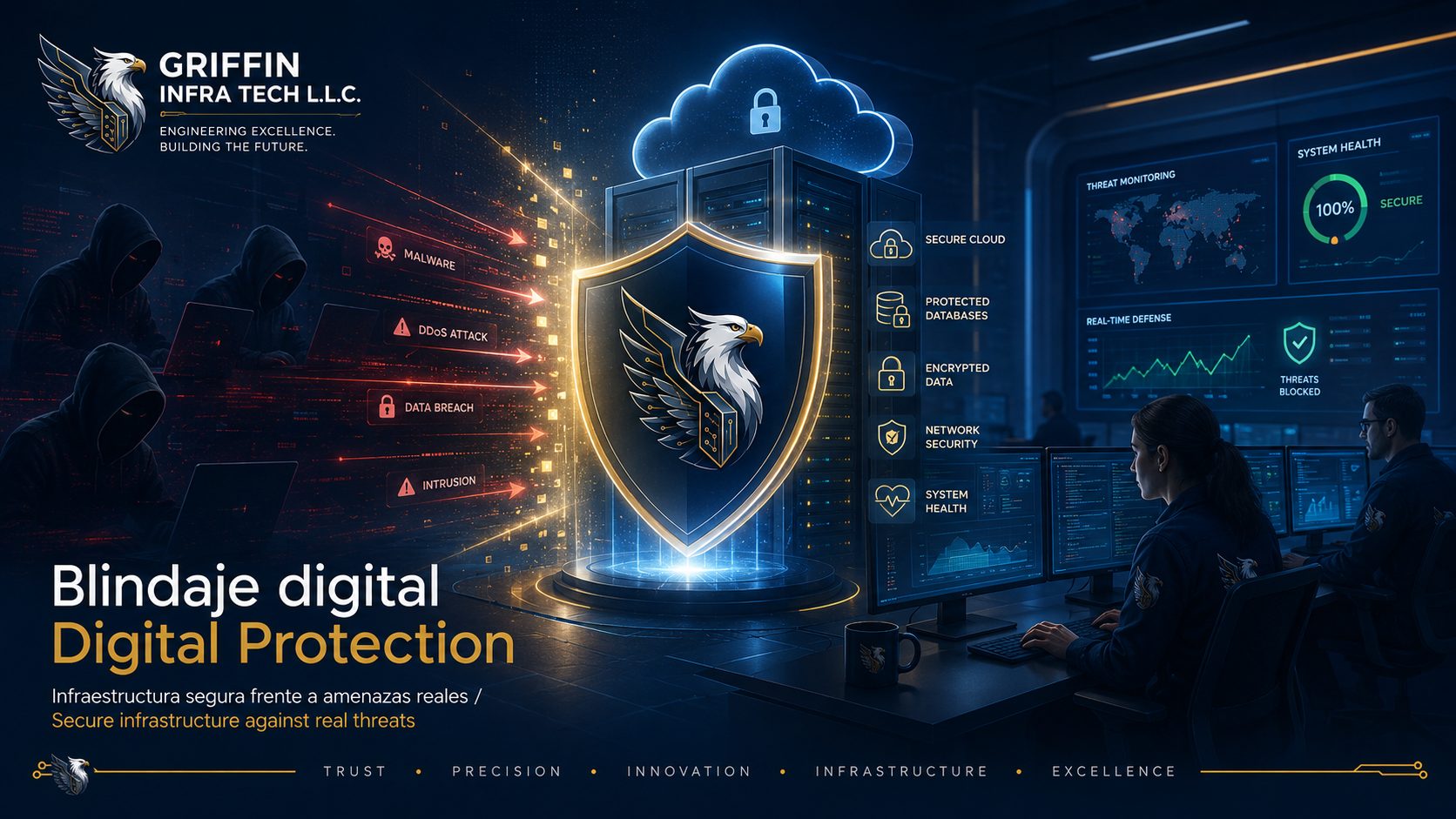
But when that infrastructure fails, reality becomes immediate: emails stop arriving, internal systems go down, files become inaccessible, computers slow down, websites go offline, backups are missing, access permissions are disorganized, or security incidents interrupt the business.
The problem is not only technical. It is operational, financial, reputational, and strategic.
Secure digital infrastructure should not be seen as a luxury reserved for large corporations. It is the minimum foundation required by any company that wants to operate with continuity, protect its information, serve its clients, and grow without depending on improvisation.
Digital Infrastructure Is Not Just Technology

When companies think about digital infrastructure, many picture only computers, internet connections, or servers. That view is incomplete.
Digital infrastructure is the set of systems, processes, tools, and controls that allow an organization to operate in a stable, secure, and coordinated way. It includes physical components, cloud services, networks, software, data, backups, access policies, monitoring, documentation, and technical support.
In business terms, digital infrastructure is the layer that allows teams to work, information to move, services to remain available, and operations to respond to failures, changes, or incidents.
A company may have good people, good products, and good clients. But if its digital infrastructure is weak, sooner or later that weakness becomes lost time, lost money, or lost trust.
The Common Mistake: Acting Only When Something Fails
Many organizations still treat technology as a reactive expense. They call support when something breaks, buy equipment only when there is no alternative, create backups after losing files, and review security only after an incident.
That model is expensive, fragile, and dangerous.
A company should not discover that it has no backup on the day it loses information. It should not review access permissions after an intrusion. It should not organize its servers after they are already down. It should not document its infrastructure only when the one person who understands the system is no longer available.
Digital infrastructure requires prevention, control, and continuity. Solving emergencies is not enough. What matters is reducing the probability of failure, detecting early warning signs, and responding with order when something inevitably goes wrong.
The Risks of Weak Infrastructure
Poorly designed or poorly managed infrastructure exposes a company to multiple risks. Some are visible; others remain hidden until a serious problem occurs.
The most common risks include:
- Loss of critical information due to unreliable backups.
- Operational interruptions caused by poorly monitored servers, networks, or services.
- Security vulnerabilities due to disorganized access or outdated systems.
- Excessive dependence on one person who understands the technical configuration.
- Lack of documentation for incident response or audits.
- Operational slowdowns caused by poorly maintained equipment, networks, or applications.
- Higher costs from solving emergencies instead of preventing them.
- Reputational damage with clients, suppliers, or business partners.
These problems do not always appear suddenly. Many grow slowly inside the company. An unmaintained computer, a shared password, an unverified backup, an unmonitored server, or an undocumented network may seem like minor details. But together, they create a fragile structure.
And fragile structures always become expensive.
What a Well-Designed Business Infrastructure Should Include
Secure digital infrastructure must be built with operational discipline, not improvisation. It is not about buying more technology. It is about organizing correctly the systems that support the business.
A solid business foundation should include at least the following elements:
- Automated and Verified Backups
Having backup copies is not enough. A backup that has not been tested is a promise, not a guarantee.
Companies need automated backups that are separated from primary systems and verified periodically. The right question is not only “Do we have backups?” but “Can we restore operations if the main system fails tomorrow?”.
- Monitoring of Critical Services
Important problems should not be discovered through complaints from clients or employees. Servers, websites, connections, internal services, storage, and critical processes must be monitored.
Monitoring helps detect failures, performance degradation, downtime, recurring errors, and events that may anticipate a larger incident.
- Access Control
Every company needs to know who has access to what, why they have that access, and when it should be removed.
Shared accounts, weak passwords, excessive permissions, and old active users are signs of insecure infrastructure. Access control is one of the most basic measures and, at the same time, one of the most ignored.
- Clear Technical Documentation
Infrastructure that only one person understands is a risk.
Technical documentation makes it possible to maintain continuity, transfer knowledge, respond to incidents, audit configurations, and avoid excessive dependence on specific individuals. Documentation is not bureaucracy. It is operational protection.
- Basic Security Applied Consistently
Security does not start with complex tools. It starts with discipline: updates, strong passwords, multi-factor authentication, basic segmentation, access policies, device reviews, malware protection, and control over exposed services.
Effective security is not an event. It is a continuous practice.
- Incident Response Planning
Every company should know what to do when a relevant failure occurs.
Who responds? Which systems have priority? Where are the credentials? Which backup is valid? How is the situation communicated internally? When should the incident be escalated?
Without a basic plan, every incident becomes improvisation.
Infrastructure, Continuity, and Trust
Digital infrastructure does not only support systems. It supports trust.
When a company responds quickly, protects information, keeps services available, and operates with order, it communicates seriousness. When everything depends on improvised solutions, trust deteriorates.
Clients do not always see infrastructure, but they experience its consequences. They notice when a company responds late, loses information, cannot access documents, has systems down, or cannot explain what happened.
That is why operational continuity is no longer a concern only for large companies. It is also a competitive factor for small and mid-sized businesses that want to look, operate, and grow like serious organizations.
The Role of Automation and Artificial Intelligence
Secure infrastructure should not remain limited to manual maintenance. Automation and artificial intelligence can help increase a company’s operational maturity.
Automation reduces repetitive tasks, generates alerts, runs scheduled processes, organizes internal workflows, and reduces human error. Artificial intelligence can support documentation review, event analysis, report generation, and organization of operational knowledge.
However, AI and automation only create real value when they are integrated on top of an orderly technical foundation.
Automating chaos does not create efficiency. It only accelerates disorder.
That is why, before discussing advanced solutions, a company needs to answer basic questions:
- Where is its critical data?
- Which systems support daily operations?
- Which services must always remain available?
- Who has access to each resource?
- What happens if a server fails?
- Which backup allows the business to recover?
- Which processes can be safely automated?
Digital maturity begins with clarity.
Where Griffin Infra Tech Fits In
Griffin Infra Tech L.L.C. was built with a clear vision: to help companies build, strengthen, and maintain digital infrastructure with technical discipline, security, and an operational mindset.
Our work is not limited to solving isolated problems. We seek to understand the operation, identify weak points, and propose solutions that help the company operate with greater stability, continuity, and control.
From continuous IT support to automation, monitoring, servers, backups, technical documentation, basic security, and tool integration, the objective is the same: to turn technology into an operational advantage, not a constant source of risk.
A serious company needs serious infrastructure. Not necessarily complex infrastructure, but infrastructure that is organized, protected, and ready to grow.
Conclusion
Digital infrastructure is invisible when it works, but it becomes obvious when it fails.
Companies that wait for an incident before acting pay more, respond worse, and remain exposed to risks that could have been reduced through prevention. In contrast, organizations that invest in secure infrastructure build a more stable foundation to operate, grow, and compete.
Servers, networks, backups, monitoring, access control, documentation, and security are not minor technical expenses. They are fundamental elements of business continuity.
In an environment where speed, trust, and availability matter more every day, secure digital infrastructure is no longer optional. It becomes a strategic necessity.
Griffin Infra Tech supports companies that understand this reality and want to build a safer, more resilient, and future-ready operation.
Authorship and Contact
Written by: Iván Guerrero
CEO & Director, Griffin Infra Tech L.L.C.
This article was developed by Griffin Infra Tech L.L.C. with the assistance of artificial intelligence for research, editorial structuring, and drafting efficiency. The final review, technical judgment, business perspective, and content direction belong to Griffin Infra Tech L.L.C.
For business inquiries, technology support, digital infrastructure, automation, or potential collaborations, contact us at:
Corporate email:
Griffin Infra Tech L.L.C.
Engineering excellence. Building the future.